Walk a trade show floor for an hour and one thing becomes obvious very quickly.
Some exhibits are packed all day. People step in, conversations are happening, badges are scanned, and the space feels energetic from the moment the doors open until the aisles finally clear out.
From a distance, that looks like success.
But spend enough time inside those environments and a different picture often emerges. Many of the interactions are brief. Visitors enter out of curiosity, look around, and move on. Staff members repeat the same quick introductions throughout the day. Products are visible, but the deeper story behind them never quite lands.
The exhibit is busy.
That doesn’t necessarily mean it’s effective.
This disconnect shows up more often than many companies realize. A booth can generate constant activity and still struggle to deliver the outcomes the event was meant to produce.
And the stakes are high. According to research from the Center for Exhibition Industry Research (CEIR), more than 80% of trade show attendees have purchasing authority. The opportunity to engage real decision makers is significant.
Which makes the next question even more important.
What outcome is the exhibit designed to produce?
The difference between busy and effective exhibits
In most cases, the difference comes down to three things:
1. Clear outcomes
The exhibit is designed around a defined goal such as qualified leads, product education, or relationship development.
2. Structured engagement
The environment guides how visitors interact with the brand, product, and staff instead of leaving interactions to chance.
3. Measurable interaction
Conversations and engagement points are designed to capture useful information that supports follow-up and post-show reporting.
When those three elements align, activity at your event becomes measurable performance.
What a “busy” exhibit looks like
Exhibits are designed to attract attention. In a crowded exhibit hall, that’s a logical priority. Impressive graphics, products on display, digital content moving to grab your attention, and custom architectural surprises all compete for the same thing: a few seconds of an attendee’s focus.
When those elements work, they bring people into the space.
The challenge is what happens next.
Without a clear plan guiding the interaction, visitors often drift through the space rather than engaging with it. A conversation may start at the edge of the aisle but never develop beyond a quick overview. A product might be interesting, but the attendee leaves before understanding how it solves their problem.

It’s common to see staff positioned along the aisle greeting every passerby while product messaging sits deeper inside the space. Visitors enter, glance around, and exit within seconds because the interaction never develops beyond the first greeting.
From the outside, the exhibit still appears active.
Inside, the engagement remains surface level.
That kind of activity rarely produces strong lead qualification, clear product understanding, or relationships that move forward after the show.
Why activity gets mistaken for success
Activity is easy to see. Results are not always as immediate.
A crowd signals momentum. Teams feel energized when the space stays active throughout the day. Leadership walking the show floor sees movement and assumes the exhibit is performing well. Photos of a crowded booth look impressive in post-show reports.
But those indicators rarely explain what really happened inside the exhibit.
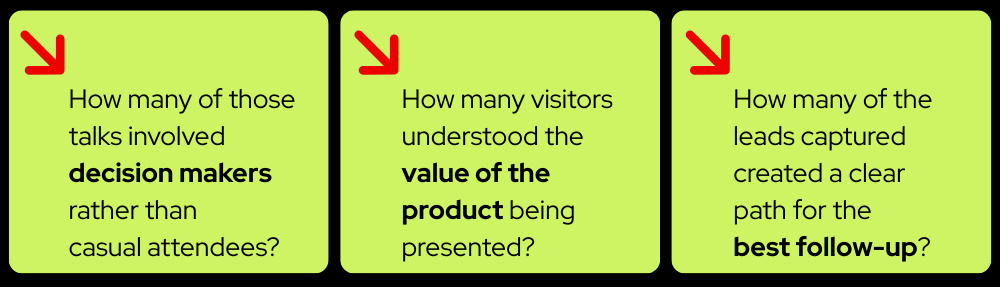
The gap between activity and results can be significant. Industry research shows that as many as 80% of trade show leads are never followed up on. That’s right, 80%!
In other words, an exhibit can collect hundreds of badge scans and still produce very little business impact.
Traffic alone does not prove an exhibit is achieving its company goals.
What outcome-driven exhibits do differently
Exhibits that consistently produce stronger results start from a different place.
Instead of beginning with how the structure will look, the process starts with a simple question.
What goal does this event need to produce for the business?
For some organizations, the priority is qualified lead generation. For others, the objective may be product education, brand positioning, or relationship development with existing customers.
Each of those goals requires a different type of environment.
- A lead-generation strategy benefits from engagement points that allow staff to quickly start conversations and qualify interest.
- A product education strategy works best when the exhibit includes structured demonstration areas or presentation zones that help attendees understand a solution clearly.
- A relationship-focused exhibit may prioritize meeting areas where deeper discussions can happen without competing with the noise of the aisle traffic.
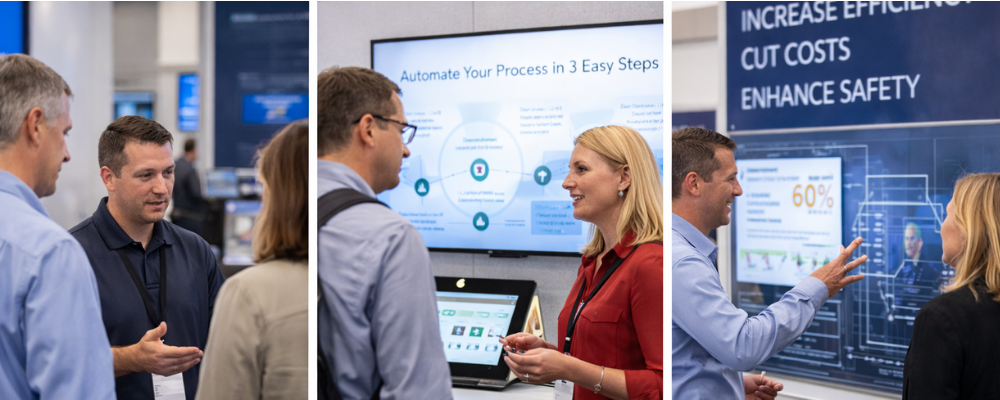
In practice, this often means mapping how interaction should happen inside the space. Where visitors naturally pause. Where staff can guide a conversation. Where the core message can be understood quickly before the attendee moves on.
These design decisions determine whether an interaction becomes a productive conversation or a brief stop along the aisle.
When those objectives guide the layout, the exhibit becomes more than a visual presence. It becomes a framework for engagement.
The shift from traffic to results
When an exhibit is designed around outcomes, the experience inside the space changes.
Conversations last longer. Visitors ask more specific questions. Staff members have the structure to guide discussions rather than relying on quick introductions.
Attendees spend time understanding the product or solution instead of scanning the environment quickly and moving on.
Lead capture becomes more insightful because the interaction has context behind it. Follow-up improves because conversations begin with a clear purpose.
Traffic turns into measurable results.
Experienced event teams often evaluate performance using more than lead volume alone.
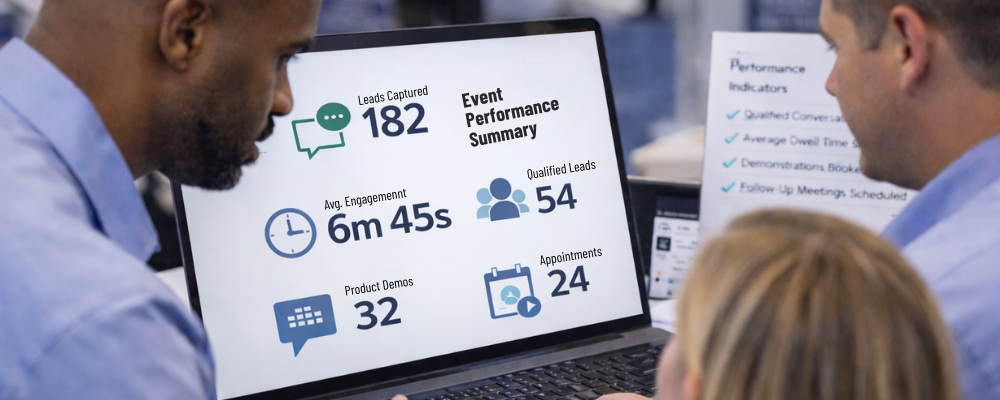
They look at indicators such as the number of qualified conversations, how long visitors remain engaged in the space, whether demonstrations lead to deeper discussions, and how many interactions result in scheduled follow-up after the show. These signals provide a clearer picture of whether the exhibit is driving real business outcomes.
Questions that should shape exhibit design
Before the design process begins, companies should be able to answer a few strategic questions.
- Who are the decision makers we need to reach at this event?
- What problem should visitors understand within the first 30 seconds?
- What type of interaction do we want to create — demonstration, education, or conversation?
- How will our team identify qualified prospects during the interaction?
- What information should be captured that will improve follow-up after the show?
- What result would define success for this event six months from now?
When those questions are clear, the exhibit can be designed to support them.
Without them, most booths default to the same goal: attract attention and hope the right people stop.
Starting with strategy
At Apple Rock, our exhibit design process begins with strategy.
Not square footage.
Not the structure.
Not visual elements alone.
Strategy.
Once the objective is clear, every element of the environment can be built to support it. Engagement pathways, storytelling elements, meeting areas, and integrated data capture all serve a defined purpose.
The real question after a trade show isn’t how busy the exhibit looked.
It’s whether the exhibit was designed to produce measurable results. We can make this happen.