There was a time when the audience was fairly easy to identify. They were standing right in front of you.
That isn’t necessarily true anymore.
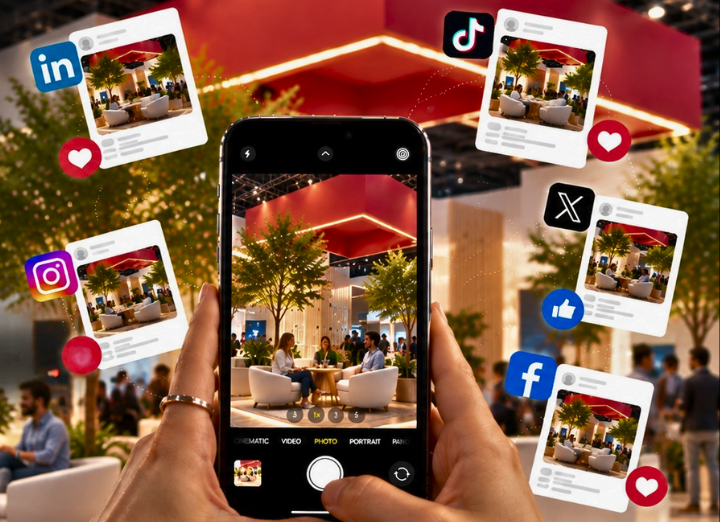
A brand activation might reach an audience of thousands in person and many more through the photos, videos and posts those people create. Even a relatively small event can suddenly have an audience far larger than you expected.
That’s an enormous opportunity for experiential marketing. It has also introduced an interesting design question.
Are we creating something that’s great to experience, or something that looks like it was great to experience?
Ideally, of course, it’s both. But… those aren’t exactly the same thing.
Experiential marketing has two audiences now
The person who is physically there takes in the scale, sound, movement, anticipation, conversation and the energy created by everyone around them. They know what happened before the photograph was taken and what happened after it. They have context.
The person encountering the experience later may get five seconds of video or a single image while scrolling through a feed.
That secondary audience matters. If 2,000 people attend a live event and thousands more encounter it through the content they create, designing with shareability in mind isn’t superficial. It’s smart marketing.
But it does mean those two audiences aren’t getting the same thing.
Something can be extraordinary in person and surprisingly unimpressive on a screen. The reverse can also be true. An installation can produce an incredible image from exactly the right angle while offering relatively little to the person standing inside it.
The challenge is making sure one audience isn’t being designed for at the expense of the other.
The camera is part of the creative brief
We’ve gotten very good at giving people reasons to pull out their phones. Dramatic reveals, immersive environments, unexpected scale and interactive elements are often designed with sharing in mind. That sharing creates content, expands reach and gives the investment a much longer life.
The danger isn’t that people take pictures. It’s allowing what will photograph well to become a substitute for what will be worth experiencing.
A shareable moment can attract attention without creating much curiosity. It can generate participation without much connection to the brand. People can remember what happened while struggling to remember who was behind it. What you create can perform beautifully on social media while being surprisingly forgettable in person.
That’s why a great photo isn’t proof of a great experience. It’s just proof that you created a great photo.
What’s shared starts shaping what gets designed
Social gives marketers something incredibly useful: visible evidence of how far an event traveled. You can count the posts, watch the reach grow and see the audience expand.
What happens in person is harder to capture. A photograph can’t tell you whether someone stayed longer than expected, learned something new, made a valuable connection or walked away thinking differently about the brand.
Designing for the people at the event is only part of the opportunity. What they choose to share can introduce the brand to people who were never there. The best ideas consider what it feels like to be there and what carries through when you’re not.
Shareable or worth sharing?
There is a subtle difference between designing a shareable experience and designing an experience people want to share.
One begins with the question, “What will people want to post?”
The other begins somewhere else: “What will people be glad they were here for?”
The answers can absolutely lead to the same idea. In fact, that’s probably where experiential marketing is at its best. The visual moment works because something interesting is happening. The content travels because people genuinely want to capture it. And someone seeing it later gets a glimpse of the thought behind what was created.
The goal isn’t to choose between the experience and the image. It’s to create something people are glad they experienced and everyone else wishes they had.