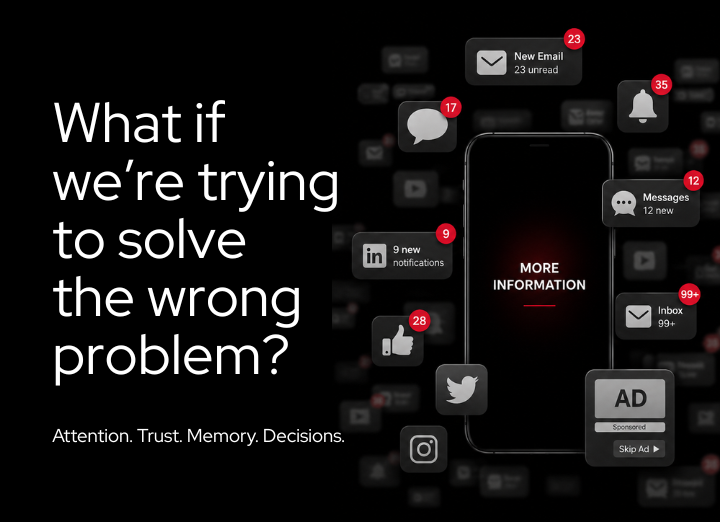
I’ve noticed something interesting about the way businesses respond to problems.
When attention is hard to get, we create more content. When trust feels difficult to earn, we provide additional proof. When decisions stall, we schedule another meeting, build another presentation, or send another email containing the information we hope will finally move things forward.
The response is so common that most of us hardly notice it anymore. If something isn’t working, the answer often seems to be more information.
On paper, the logic makes perfect sense. People cannot act on what they do not know, so providing more knowledge should create more understanding, more confidence, and better decisions. Yet the longer I think about it, the more I wonder why so many of the challenges businesses face today continue to exist despite living in the most information-rich environment in history.
After all, we have become remarkably good at delivering messages. Companies have more ways to reach people than ever before, making it possible to deliver the same message through email, social media, digital advertising, webinars, websites, podcasts, videos, text messages, and a growing list of other channels without ever speaking to another person.
Which made me wonder if we’ve been looking at some of these challenges the wrong way.
We often assume people aren’t paying attention because they need more information. In reality, they may not be paying attention because they’re already carrying too much of it.
The more I thought about that possibility, the more other challenges started to look different as well. Maybe trust isn’t always a lack of proof. Maybe being forgotten isn’t always a lack of visibility. Maybe hesitation isn’t always a lack of information.
Perhaps we’ve become so accustomed to solving problems with information that we sometimes overlook the human behavior shaping the outcome.

Most of us spend a surprising amount of our day sorting, filtering, deleting, skipping, muting, and scrolling. The challenge is not finding information. The challenge is deciding which information deserves our attention. Every notification, advertisement, article, email, and update arrives believing it should be the next thing we care about, yet most are forgotten before the day is over.
The challenge facing many organizations is no longer finding a way to communicate. It is finding a reason for someone to stop and care.
The more I thought about it, the harder it became to ignore a strange contradiction. We have access to more information than ever before, yet confidence often feels surprisingly difficult to earn. We read reviews, compare sources, seek recommendations, and look for reassurance from people we trust. Facts matter, but facts alone rarely settle the question. Trust has always depended on something more complicated than information. It develops through observation, experience, and interaction, which may explain why some conversations accomplish more than an entire library of marketing materials.
Then again, trust isn’t the only thing information struggles to create. Sometimes it struggles to leave any lasting impression at all. Every organization competes for attention, but attention and memory are not the same thing.
Being seen is relatively easy. Being remembered is much harder.
Most messages disappear almost immediately, not because they were poorly written or badly designed, but because human beings encounter far more information than they can realistically retain. Our brains are constantly making decisions about what is worth keeping and what can be discarded.
The result is that information often passes through our lives, while experiences have a way of staying with us.
And if information doesn’t guarantee attention, trust, or memory, it probably shouldn’t surprise us that it doesn’t always simplify decisions either. Even decision-making, which seems like it should improve as information increases, often moves in the opposite direction. More options can create hesitation. More opinions can create uncertainty. More research can create doubt. Anyone who has spent weeks comparing alternatives only to feel less certain than when they started understands this phenomenon.
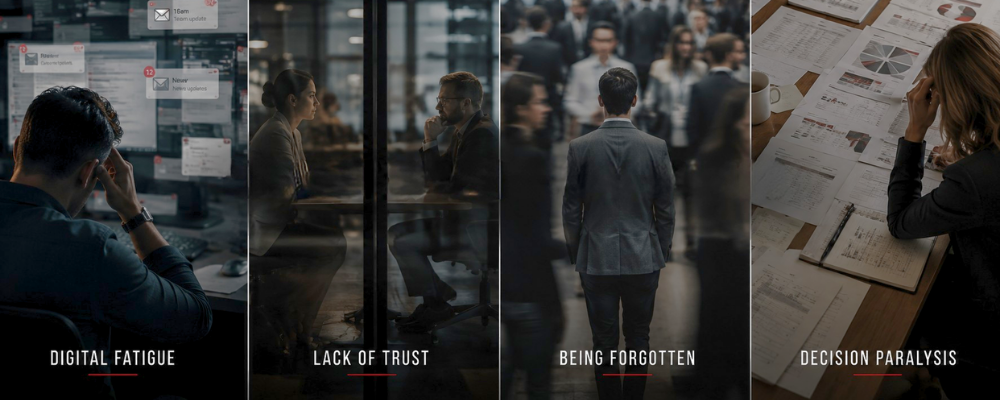
By this point, I started wondering whether these were really four separate challenges at all, or different expressions of the same underlying problem.
Digital fatigue, lack of trust, being forgotten, and decision paralysis may look like different problems on the surface, but they all seem to point back to the same thing. Each one is rooted in the way people process information rather than the amount of information they receive. Technology continues to change how messages are delivered, but it has done far less to change the way people pay attention, build trust, form memories, and make decisions.
That is why face-to-face experiences continue to hold such value.
Not because they replace information, but because they address something information alone often struggles to accomplish. They give people a reason to pay attention, opportunities to build confidence, moments worth remembering, and clarity that helps them move forward. Technology can change how information is delivered, but it has far less influence over how people respond to it.
Which may explain why some of our most persistent business challenges continue to resist information-based solutions.
They were never information problems in the first place. They were human ones.
Related Insights
- A Great Photo Isn’t Proof of a Great Experience
 Experiential marketing has two audiences: the people who are there and the people who experience it later through a screen. As shareability becomes part of the creative brief, there’s an important distinction between creating something people want to post and something they’re glad they experienced.
- What If We’re Trying to Solve the Wrong Problem?Companies have more ways to reach people than ever before, yet attention remains difficult to earn, trust remains difficult to build, and decisions still stall. Perhaps some of our most persistent business challenges were never information problems to begin with.
- Why Do Some Experiences Stay With Us?Months of planning can result in an experience people remember only in pieces. Why? This article explores how memory shapes what we keep, what we forget, and why memorable design may have less to do with creating more and more to do with understanding what the brain chooses to preserve.