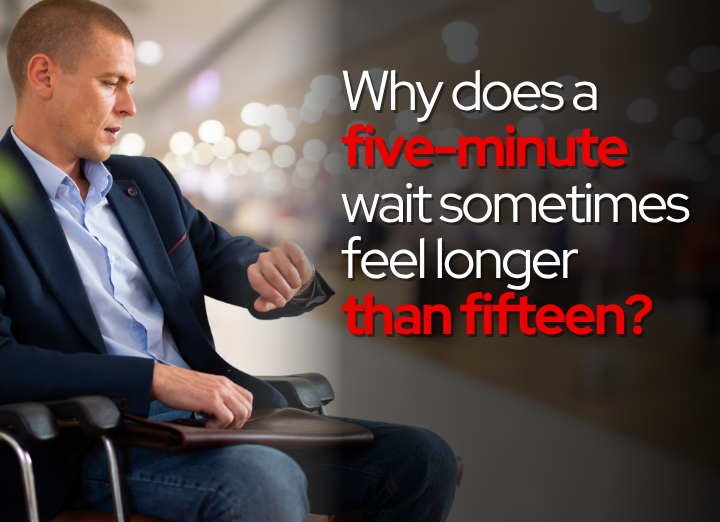
Time is funny.
Five minutes isn’t always five minutes.
Sometimes you’re standing in line at the grocery store wondering why the cashier seems to have disappeared into another dimension. You glance at your watch, then your phone, then back at the register. Surely, you’ve been standing there for at least ten minutes.
You haven’t.
Then there are other moments when you’re waiting for a table at your favorite restaurant. You’re halfway through a conversation, someone starts telling a funny story, and before they reach the punchline your name is called.
The clock measured the same five minutes. Your brain didn’t. That raises an interesting question.
Why are we perfectly willing to wait in some places but become impatient almost instantly in others?
Most of us assume the answer is simple. One wait must have been longer than the other.
Psychologists would tell you that’s only part of the story.
For decades, they’ve studied how people experience time, and one of the most consistent findings is that our brains don’t simply measure minutes. We measure something much harder to see. Uncertainty, expectations, progress, and whether the experience unfolding around us feels worthwhile.
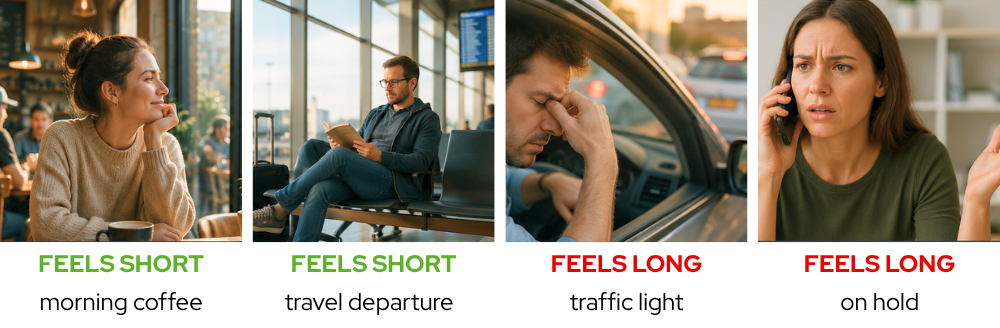
In other words, we don’t judge how long we’re waiting. We judge what the wait means.
One of the first researchers to explore this idea was psychologist David Maister. His work on the psychology of waiting continues to influence industries ranging from healthcare to hospitality because he recognized something most of us experience without ever thinking about it. Waiting is just as much a psychological experience as it is a mathematical one. Since then, decades of research have continued to reinforce his findings. Expectations shape satisfaction. Uncertainty stretches time. Communication and visible progress often make the exact same wait feel noticeably shorter.
The minutes matter.
The meaning matters more.
Think about the last time you walked into a store where you expected to wait.
Maybe it was an Apple Store. Maybe it was somewhere else. An employee greeted you, checked you in, and let you know someone would be with you in about twenty minutes. You probably didn’t love hearing it, but you accepted it almost immediately. You wandered through the store, picked up products you had no intention of buying, watched someone else test out a new device, and before long someone called your name.
Now picture yourself standing in line at a discount retailer with one register open.
The wait might actually be shorter.
Yet somehow it feels longer.
Nothing about the clock has changed. What’s changed is the story your brain is telling you. In one situation, the wait suggests expertise, demand, and an experience that’s worth your time. In the other, it suggests inefficiency. You’re no longer judging the length of the line. You’re judging what the line says about the business.
Once you start looking at the world through that lens, you begin noticing it everywhere.
Airports are a perfect example. Flights are delayed every day, but airports work surprisingly hard to make sure passengers understand what’s happening. Departure boards update constantly. Gate changes appear almost immediately. Announcements explain delays, boarding groups, and revised departure times. None of those updates get the airplane into the air any faster, but they answer the question every traveler is quietly asking: Does anyone know what’s going on?
When people understand what’s happening, they’re remarkably patient. When they don’t, their minds start filling in the blanks. Maybe they forgot about me. Maybe no one knows I’m here. Maybe this company isn’t very organized. Most of the time those assumptions aren’t true, but perception has a funny way of becoming reality.
The same thing happens in business.
Businesses spend enormous amounts of energy trying to reduce friction, shorten wait times, and move customers through an experience more efficiently. Those things matter, and no one would argue that making customers wait longer is a good strategy.
But psychology suggests something more interesting.
The goal isn’t simply to eliminate every wait. It’s to make sure every moment reinforces what you want customers to believe about your company.

Think back to the Apple Store. Most people don’t leave frustrated by the wait. They leave believing the store is busy, well-organized, and worth their time. The wait didn’t damage the experience because it reinforced what people already believed about the brand. It felt like part of the experience, not a failure of it.
The same psychology follows people into every customer experience. Whether they’re walking into your headquarters, touring a manufacturing facility, attending a customer event, or stepping into your exhibit, they’re constantly gathering clues. Not just about the environment, but about the company itself. Every interaction, every transition, and every detail quietly answers a question they may never ask out loud:
“If this is what it’s like to spend an hour with this company, what would it be like to do business with them?”
That’s why thoughtfully designed customer experiences matter. Every moment before the conversation is an opportunity to reinforce trust, confidence, and credibility.
Because in the end, people rarely remember exactly how many minutes passed.
They remember what those minutes led them to believe about your company.
Related Insights
- Why Do Some Experiences Stay With Us?
 Months of planning can result in an experience people remember only in pieces. Why? This article explores how memory shapes what we keep, what we forget, and why memorable design may have less to do with creating more and more to do with understanding what the brain chooses to preserve.
 - Why Does a Five-Minute Wait Sometimes Feel Longer Than Fifteen?We’ve all experienced it. One five-minute wait feels endless while another is over before we realize it. The psychology behind that difference reveals something every business should understand about customer perception.
- Trade Shows Aren’t the Only Place Customer Relationships Are BuiltTrade shows are an important part of building new business, but they don’t have to be the only place customer relationships grow. Discover how hosted events, branded environments, and regional experiences can create deeper conversations, stronger connections, and lasting trust.