I may be dating myself here, but there was a time when preparing for a trade show meant getting your exhibit ready, making sure the sales team knew where to be, ordering a few promotional items, and hoping nobody forgot to pack the literature.
Okay, you got me there. It was never quite that simple. Trade shows have always involved an impressive amount of planning, paperwork, and people trying to get things done on impossible deadlines. But somewhere along the way, the list of things an exhibitor is now expected to accomplish got considerably longer.
The pre-show email campaign now has a social media calendar to coordinate with. Appointment scheduling has its own software. Product launches come with video requests, interactive experiences need technical support, and lead capture comes with a dashboard full of data someone needs to interpret. Someone wants a hospitality event. Someone else has an idea for an attendee engagement campaign. And leadership wants measurable results, preferably before everyone’s finished unpacking.
Oh, and the exhibit still needs to look incredible.
We keep adding things
The funny thing is, very few of these additions are bad ideas. Digital lead capture was an improvement over collecting business cards in a fishbowl. Online scheduling made coordinating those meetings easier. Interactive technology opened up possibilities for demonstrating products that couldn’t easily be brought into the booth. Even the endless stream of digital content (usually requested from marketing at the last possible minute) has its place. Companies have more ways than ever to reach people before an event, share what’s happening during the show, and keep the conversation going afterward.
Each advancement solved a problem or created a new opportunity. But we rarely seem to retire anything when something new comes along.
At some point, a trade show stopped being an event a company attended and became an entire campaign that happened to include an event. That evolution has brought some impressive results. Exhibitors can be more targeted, more prepared, and better connected to their audiences than ever before. They can also spend an extraordinary amount of time preparing to be prepared.
It used to be relatively easy to identify who was responsible for the trade show. These days, depending on the company, the answer might be just about everybody.
Marketing has its campaigns to coordinate. Sales has appointments to schedule. Product teams have demonstrations to prepare. And somewhere in the middle of all that, someone has to make sure the exhibit, equipment, and people arrive at the convention center when they’re supposed to.
The challenge isn’t necessarily having more people involved. It’s that each department sees the event through its own responsibilities, and a perfectly reasonable request from one team can create an unexpected amount of work for another.
For example, a product manager may want a live demonstration. Great idea! Except now it needs dedicated power, an internet connection, equipment shipped separately, a backup plan, and someone who knows what to do when the software decides to update itself ten minutes before the show opens. The demonstration itself lasts six minutes. Getting it ready takes six weeks.
Meanwhile, marketing is waiting for the final product messaging, sales needs the demonstration schedule, and the exhibit manager is trying to determine whether the additional equipment changes the electrical order. And somehow, the person coordinating the event is expected to know about all of it.
Nobody Wants to Be the One Who Says “No”
It’s much easier to suggest adding something than to explain why it shouldn’t be included.
A video wall would be great for the product launch. A private meeting room would be useful for important customers. Recording interviews during the event could provide weeks of social media content. All reasonable suggestions, and each one has someone who believes in it.
That’s where things get complicated. Every new idea has an advocate. Someone can explain what it will accomplish, why it’s worth doing, and what the company might miss if it gets left out. But who’s advocating for everything that needs to happen to make those ideas work?
We all know there’s only so much space in an exhibit, so much time in the schedule, and so much attention a team can give to visitors while managing everything else. And nobody particularly enjoys being the person who says, “That’s a good idea, but we’re not doing it.”
The better approach is deciding which ideas will make the biggest difference at the show. Sometimes that means investing in something ambitious. Other times, it means making sure the team has enough time to talk with the people who came to see them.
The possibilities available to exhibitors today are incredible. Better technology, more flexible exhibit systems, and new ways to connect with audiences have opened doors that weren’t available years ago. There’s a lot to be excited about.
So when did trade shows become so complicated? Probably somewhere between the first great idea and the fifteenth. And the funny thing is, we wouldn’t necessarily want to give any of them up.
Maybe the trick isn’t coming up with fewer ideas. It’s figuring out which ones are worth all the work that comes with them.
Related Articles
- When Did Trade Shows Become So Complicated?
 Trade shows have come a long way. Better technology, more sophisticated experiences, and more ways to connect with audiences have opened up incredible possibilities. But somewhere between the first great idea and the fifteenth, the planning process got a whole lot more complicated. And somehow, every new idea comes with another thing someone has to figure out how to make happen.
- Why Your Sales Team Should Influence the FloorplanSales knows what needs to happen at a trade show, even if they don’t know how that should translate into a floorplan. Bringing that knowledge into exhibit planning can shape the space and reveal what the sales team has learned once the event begins.
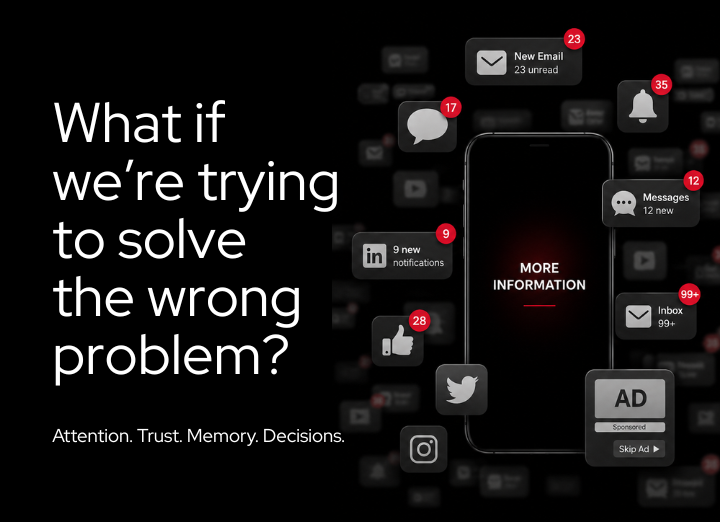
- What If We’re Trying to Solve the Wrong Problem?Companies have more ways to reach people than ever before, yet attention remains difficult to earn, trust remains difficult to build, and decisions still stall. Perhaps some of our most persistent business challenges were never information problems to begin with.